It looks like you can write a minimalist piece without much bleeding—
And you can. But not a good one…
David Foster Wallace
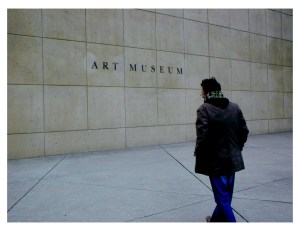 So with that in mind: I’d like to begin with an idea I had about using stray cats as temporary ‘cats-eyes’. They might not be as hardy as the real thing, but at least you could run over them nine times before replacing them— that said, I am in no way condoning the use of animals as traffic signals or road signs: I love cats, and with any luck the rest’ll be a little less cruel.
*
Minimalism is very much like dance— ballet to be exact— I am utterly baffled by it. It seems to demand a rather off-putting level of technical knowledge, knowledge I’m afraid would require me to slip into a pair of tights to fully gather. For instance, unless the performer actually falls over, it’s hard to know whether they were dancing moderately or spectacularly.
The same is true of classical music and art— where only an expert can really detect a wrong note or incompetent brush stroke— but with those forms we have the compensations of emotion, colour and story— except, admittedly, in the case of atonal music and art of the blank or practically-blank variety. And it seems that dance, whether classical or contemporary, shares with minimalist symphonies and abstract painting, a problem of narrative.
While great art can contain no story and bad art can consist of nothing but plots, our natural instinct when faced with entertainment is to try to extract a tale or meaning. When watching ballet, I was never sure whether to think he’s pissed with her or she’s trying to stab him or he’s asking the gods for, I don’t know— something?
The problem is that we’re most comfortable with art that achieves its effects verbally. It’s no coincidence that the mass art-forms are literature, cinema, pop, television and theatre. Even with a Beethoven or Mozart symphony, it’s comforting to have a programme or sleeve note revealing what the piece is about.
With dance I always felt as if the audience had to provide mental subtitles for what is essentially a silent film. Some choreographers compensate for this with the use of mime, but this just repels me further— mime being the only art form lower on my list than ballet.
I can only speak for myself, but I’ve found that learning about anything, not only improves your understanding of it, but also your ability make fun of it; should you need to lighten the mood in the the company of over-bearing pretentiousness of course. As such, I think it’s a point that should be hammered home in schools: if the class clowns think they’re funny now, imagine how funny they could be if they could read. The country that does will top the world’s league tables for achievement.
Minimalism is one of those things that needs to be snickered at I think, if not openly mocked— not just because it’s crap and because of the people it attracts— but for a combination of the two. There’s nothing better than observing the complete abandonment of reason that stalk those who follow it.
It just doesn’t have the stories. No matter how you attempt to roll it off the tongue, minimalism is dull:
A 20th century art movement stressing the reduction of work into a minimum number of colours, shapes, lines and texture with no attempt to represent or symbolise anything. It is sometimes called ABC art, minimal art, reductivism, and rejective art.
Now that just about sums it up for me: no attempt to represent or symbolise anything… For example:
Frank Stella, whose pin-striped paintings feature nothing but straight lines running parallel to the edges of the canvas for instance, delivered the ultimate sound-bite of minimalist philosophy, when he declared there was nothing besides the paint on the canvas and what you see is what you see. Wow!
Salvador Dali once gave a lecture in a deep-sea diving suit but had to be extracted from his metal helmet with pliers after becoming asphyxiated. Hilarious, but to a minimalist? I can imagine them either turning up their noses or suggesting he should have done it behind a screen, silently, with no audience— in darkness. What you cannot see therefore, is something you simply cannot see. A kind of Minimalism without the effort.
And what greater expression of minimalism could there be than not turning up to give a lecture no one would be present for anyway? I can imagine them patting themselves on the backs and marvelling at their brilliance and how triumphantly clever they are and wondering why no one had thought of it before.
That said, they must make wonderful house-guests, providing your plates are the right shade of white and the food is all the same colour. Quite…
The Minimalist sedulously eschew obfuscatory hyper verbosity and prolixity, in the smallest possible way of course— and therein is its charm.
As for me, I think I’m far too simple to really get it, beyond the facile syllogism it is what it is, but perhaps that’s the point. I like simple things, like carrier bags, no doubt for similar reasons: every time I go to the cinema there always seems to be hordes of children running about with them over their shoes. I don’t know why and I don’t particularly want to know. I won’t think less of them for their fashion choices and it’s not as if I will take a camera crew to their house and get the neighbours to re-decorate it.
But some people would; and decorators are as culpable as any for the proliferation of minimalistic lexis:
-
Share space between different uses
-
Remove formal spaces
-
Add double-height space
-
Reduce circulation paths
-
Build furniture into rooms
-
Use bedrooms for sleeping
-
Add a focal point
-
Bring in the outdoors
-
Invite natural light
-
Tie spaces together
-
Reveal the structure
-
Be playful and imaginative
-
Separate spaces
-
Plan for flexibility
And all these things appear quite normal until you actually start to combine a couple of them— and then you get to the bottom of what they really mean. These are not scholars of the English language, otherwise they’d not’ve bothered. This is ‘verbosity’ merely posing as minimalism: bob-a-jobbers posing as intellectuals or stylists or whatever the professional nomenclature is these days…
The tying of spaces together to separate spaces make for endless hours of shuffling, especially once any formality of space has been withdrawn. But then again, what you see is what you see, so let us reveal the structure by bringing the inside out, whilst bringing the outside, inside-in; inviting ‘in’ the natural light to accompany the focal point. Hell, why not an indoor water feature?
Perhaps then we could entice raccoons to dinner; the sun past the zenith; sing a one word hymn to the dribble of damp bamboo; and find a way to squeeze through the space that was once formal.
I am curious though, as to how one actually reduces circulation paths unless you‘re actually tying spaces together: wouldn’t that cause asphyxiation and require evacuation with pliers? And how does one share space between different uses unless the different uses are in fact the separation and binding of space— is it prior to them being de-formed? Surely this taints the principal behind it somewhat.
If it is what it is— it must surely and can only mean, that it is and wants to be a de-form of some kind. Or perhaps it has no choice? Anti-art for no-one’s sake whatsoever.
And this is before we’ve been playful and imaginative by building our furniture into rooms. I know I can do it— especially after adding a double height ceiling; but how this would squeeze into the minimalist ethos, I’m not entirely sure.
As for extreme minimalism, I suppose less truly does mean more and to hell with ceilings altogether.
Thinking about it now though leaves me strangely depressed. Perhaps I should have stuck to thinking about:
-
aubergine juggling and
-
novelty uses for children as expressions of style;
-
all the other all important questions I haven’t addressed, including:
-
Is there room for growth in minimalism?
-
What do they really call themselves?
And if so, where does it go next?
I value little my own opinions but I value just as little those of others…
Michel de Montaigne
 There a lots of reasons why I started actually writing things down again. One of the isn’ts, was a fear I’d run out of thoughts should I ever to feel the need to just write; granted, I’ve kicked myself from time to time for being so complacent, but when not-actually writing things down is the healthy alternative, you must be philosophical about it; what comes with ease, likewise goes–– and with any luck will do again. I think anyone who’ve ever wanted to go through the motions of transcribing their brains, will agree that it helps to have something in it: a maraca therefore, is preferable to a balloon.
 Just a Little Background Noise 2.0